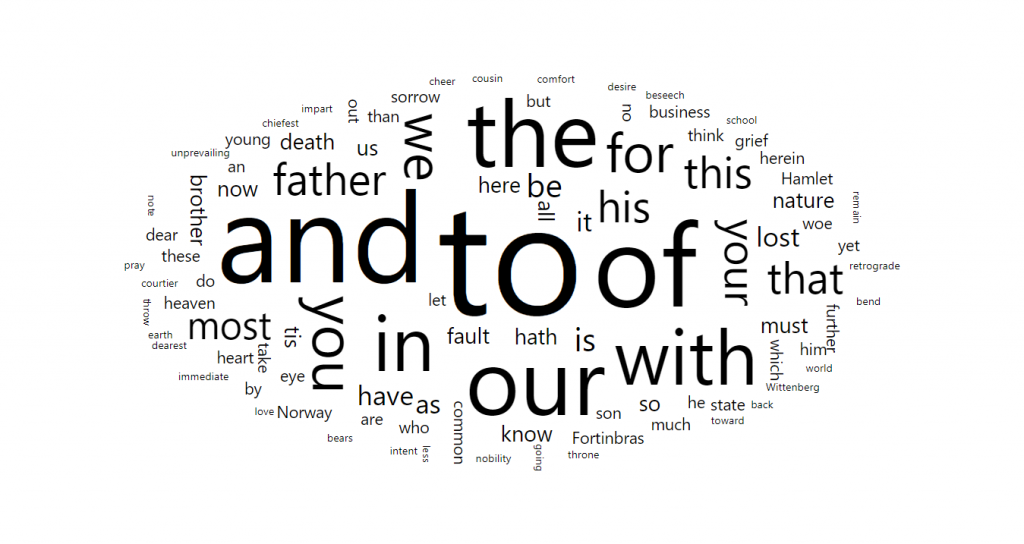
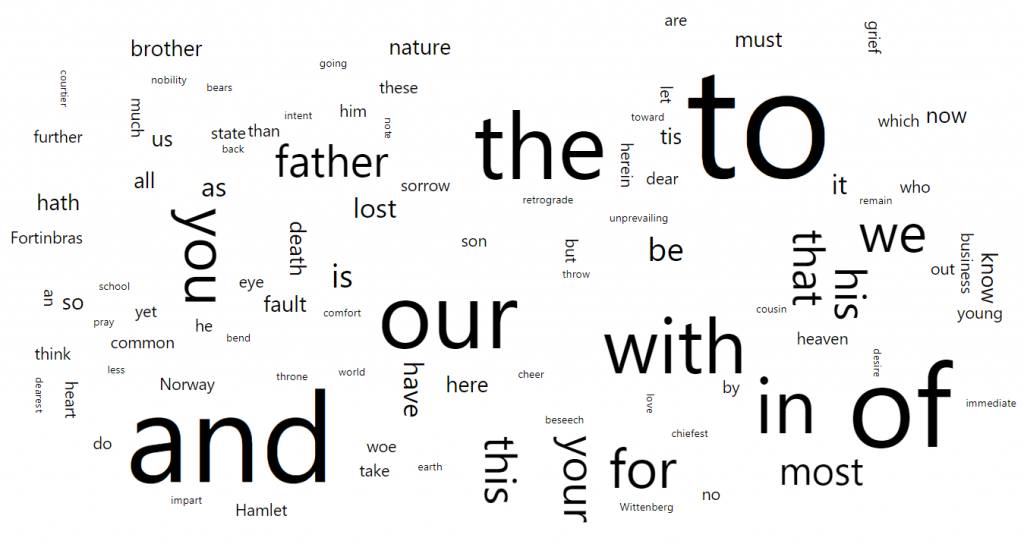
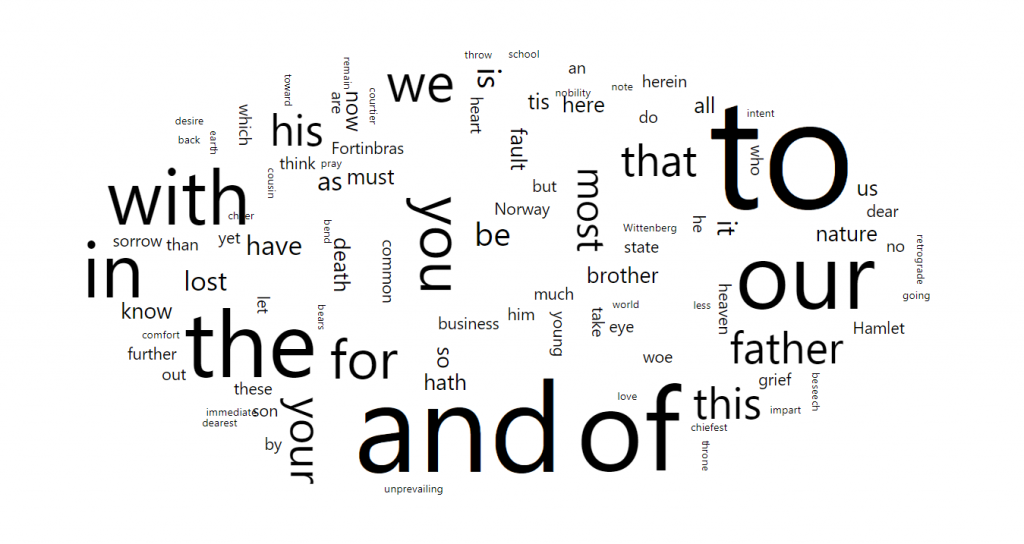
Needless to say, before you can use modules/objects, you need to make sure all required modules (in TypeScript), or files (in JavaScript) are imported. Please refer to our Getting started articles for more details:
Word Cloud comes in a form of a plugin. To start using it we will need to include both core (main module) and charts modules, as well as wordCloud plugin.
We’ll be importing and referring these as am4core, am4charts, and am4plugins_wordCloud in the course of this article, and overall in our demos and tutorials.
As we mentioned earlier, the chart needs to have at least one series. It is created just like on any other serial chart: create a series object (in this case it’s WordCloudSeries) and push it to chart’s series list:
var chart = am4core.create("chartdiv", am4plugins_wordCloud.WordCloud);
var series = chart.series.push(newam4plugins_wordCloud.WordCloudSeries());
series.text=
"Though yet of Hamlet our dear brother's death The memory be green, and that it us befitted To bear our hearts in grief and our whole kingdom To be contracted in one brow of woe, Yet so far hath discretion fought with nature That we with wisest sorrow think on him, Together with remembrance of ourselves. Therefore our sometime sister, now our queen, The imperial jointress to this warlike state, Have we, as 'twere with a defeated joy,-- With an auspicious and a dropping eye, With mirth in funeral and with dirge in marriage, In equal scale weighing delight and dole,-- Taken to wife: nor have we herein barr'd Your better wisdoms, which have freely gone With this affair along. For all, our thanks. Now follows, that you know, young Fortinbras, Holding a weak supposal of our worth, Or thinking by our late dear brother's death Our state to be disjoint and out of frame, Colleagued with the dream of his advantage, He hath not fail'd to pester us with message, Importing the surrender of those lands Lost by his father, with all bonds of law, To our most valiant brother. So much for him. Now for ourself and for this time of meeting: Thus much the business is: we have here writ To Norway, uncle of young Fortinbras,-- Who, impotent and bed-rid, scarcely hears Of this his nephew's purpose,--to suppress His further gait herein; in that the levies, The lists and full proportions, are all made Out of his subject: and we here dispatch You, good Cornelius, and you, Voltimand, For bearers of this greeting to old Norway; Giving to you no further personal power To business with the king, more than the scope Of these delated articles allow. Farewell, and let your haste commend your duty. Tis sweet and commendable in your nature, Hamlet,To give these mourning duties to your father: But, you must know, your father lost a father; That father lost, lost his, and the survivor bound In filial obligation for some term To do obsequious sorrow: but to persever In obstinate condolement is a course Of impious stubbornness; 'tis unmanly grief; It shows a will most incorrect to heaven, A heart unfortified, a mind impatient, An understanding simple and unschool'd: For what we know must be and is as common As any the most vulgar thing to sense, Why should we in our peevish opposition Take it to heart? Fie! 'tis a fault to heaven, A fault against the dead, a fault to nature, To reason most absurd: whose common theme Is death of fathers, and who still hath cried, From the first corse till he that died to-day, 'This must be so.' We pray you, throw to earth This unprevailing woe, and think of us As of a father: for let the world take note, You are the most immediate to our throne; And with no less nobility of love Than that which dearest father bears his son, Do I impart toward you. For your intent In going back to school in Wittenberg, It is most retrograde to our desire: And we beseech you, bend you to remain Here, in the cheer and comfort of our eye, Our chiefest courtier, cousin, and our son.";
By default, text parser will take and show every single word in the text.
You can tweak it to your needs using a number of options, like limiting number of words shown, or requiring word to be of certainly length, or even excluding particular words from the results.
We’ve outlined some of the most important settings in the below table:
Setting
Type
Default
Comment
excludeWords
string[]
[]
Do not include these words in the cloud.
maxCount
number
-
Maximum number of words to show. The words with least occurrences will be removed from results first
minValue
number
1
Include words with at least X occurrences.
minWordLength
number
1
Minimum number of characters in a word to be included in results.
Let’s try eliminating most common words and restrict word length:
var chart = am4core.create("chartdiv", am4plugins_wordCloud.WordCloud);
var series = chart.series.push(newam4plugins_wordCloud.WordCloudSeries());
series.maxCount=100;
series.minWordLength=2;
series.excludeWords= ["the", "an", "to"];
series.text=
"Though yet of Hamlet our dear brother's death The memory be green, and that it us befitted To bear our hearts in grief and our whole kingdom To be contracted in one brow of woe, Yet so far hath discretion fought with nature That we with wisest sorrow think on him, Together with remembrance of ourselves. Therefore our sometime sister, now our queen, The imperial jointress to this warlike state, Have we, as 'twere with a defeated joy,-- With an auspicious and a dropping eye, With mirth in funeral and with dirge in marriage, In equal scale weighing delight and dole,-- Taken to wife: nor have we herein barr'd Your better wisdoms, which have freely gone With this affair along. For all, our thanks. Now follows, that you know, young Fortinbras, Holding a weak supposal of our worth, Or thinking by our late dear brother's death Our state to be disjoint and out of frame, Colleagued with the dream of his advantage, He hath not fail'd to pester us with message, Importing the surrender of those lands Lost by his father, with all bonds of law, To our most valiant brother. So much for him. Now for ourself and for this time of meeting: Thus much the business is: we have here writ To Norway, uncle of young Fortinbras,-- Who, impotent and bed-rid, scarcely hears Of this his nephew's purpose,--to suppress His further gait herein; in that the levies, The lists and full proportions, are all made Out of his subject: and we here dispatch You, good Cornelius, and you, Voltimand, For bearers of this greeting to old Norway; Giving to you no further personal power To business with the king, more than the scope Of these delated articles allow. Farewell, and let your haste commend your duty. Tis sweet and commendable in your nature, Hamlet,To give these mourning duties to your father: But, you must know, your father lost a father; That father lost, lost his, and the survivor bound In filial obligation for some term To do obsequious sorrow: but to persever In obstinate condolement is a course Of impious stubbornness; 'tis unmanly grief; It shows a will most incorrect to heaven, A heart unfortified, a mind impatient, An understanding simple and unschool'd: For what we know must be and is as common As any the most vulgar thing to sense, Why should we in our peevish opposition Take it to heart? Fie! 'tis a fault to heaven, A fault against the dead, a fault to nature, To reason most absurd: whose common theme Is death of fathers, and who still hath cried, From the first corse till he that died to-day, 'This must be so.' We pray you, throw to earth This unprevailing woe, and think of us As of a father: for let the world take note, You are the most immediate to our throne; And with no less nobility of love Than that which dearest father bears his son, Do I impart toward you. For your intent In going back to school in Wittenberg, It is most retrograde to our desire: And we beseech you, bend you to remain Here, in the cheer and comfort of our eye, Our chiefest courtier, cousin, and our son.";
You can also go around Word Cloud’s text parser and pass in your list of words along their weights.
A data consists of an array of objects. Each object represents a word and has to have at least two keys: word (the word) and value (number of times word appear, or its weight).
Series property responsible for identifying possible angles is named predictably angles.
It’s an array of numbers, and the default is [0, 0, 90] meaning that words can come at zero (horizontal) or 90 (vertical) angle, with the former coming twice as much because it is listed twice.
In current version no other angles than 0 and 90 is supported.
To make all words horizontal, set it to [0]. To make all vertical, use [90].
It’s also possible to modify word color based on its position within the range of weights from total words in the series.
For that we can use “heat rules”. Our “Heatmaps” section of “Series” article has more details, but basically, heat rules allow assigning an intermediate value in the spectrum of values based on item’s value.
In our case we can automatically make more important words “hotter”.
"Apple Color Emoji", "Segoe UI Emoji", "Segoe UI Symbol";
}
#chartdiv {
width: 100%;
height: 350px;
}
Word Cloudword-cloud-7
You’re note limited to just color, though. You can use any quantifiable property for those as well, such as opacity, and many others. You can also combine several heat rules.
var chart = am4core.create("chartdiv", am4plugins_wordCloud.WordCloud);
var series = chart.series.push(newam4plugins_wordCloud.WordCloudSeries());
series.maxCount=100;
series.minWordLength=2;
series.excludeWords= ["the", "an", "to"];
series.text=
"Though yet of Hamlet our dear brother's death The memory be green, and that it us befitted To bear our hearts in grief and our whole kingdom To be contracted in one brow of woe, Yet so far hath discretion fought with nature That we with wisest sorrow think on him, Together with remembrance of ourselves. Therefore our sometime sister, now our queen, The imperial jointress to this warlike state, Have we, as 'twere with a defeated joy,-- With an auspicious and a dropping eye, With mirth in funeral and with dirge in marriage, In equal scale weighing delight and dole,-- Taken to wife: nor have we herein barr'd Your better wisdoms, which have freely gone With this affair along. For all, our thanks. Now follows, that you know, young Fortinbras, Holding a weak supposal of our worth, Or thinking by our late dear brother's death Our state to be disjoint and out of frame, Colleagued with the dream of his advantage, He hath not fail'd to pester us with message, Importing the surrender of those lands Lost by his father, with all bonds of law, To our most valiant brother. So much for him. Now for ourself and for this time of meeting: Thus much the business is: we have here writ To Norway, uncle of young Fortinbras,-- Who, impotent and bed-rid, scarcely hears Of this his nephew's purpose,--to suppress His further gait herein; in that the levies, The lists and full proportions, are all made Out of his subject: and we here dispatch You, good Cornelius, and you, Voltimand, For bearers of this greeting to old Norway; Giving to you no further personal power To business with the king, more than the scope Of these delated articles allow. Farewell, and let your haste commend your duty. Tis sweet and commendable in your nature, Hamlet,To give these mourning duties to your father: But, you must know, your father lost a father; That father lost, lost his, and the survivor bound In filial obligation for some term To do obsequious sorrow: but to persever In obstinate condolement is a course Of impious stubbornness; 'tis unmanly grief; It shows a will most incorrect to heaven, A heart unfortified, a mind impatient, An understanding simple and unschool'd: For what we know must be and is as common As any the most vulgar thing to sense, Why should we in our peevish opposition Take it to heart? Fie! 'tis a fault to heaven, A fault against the dead, a fault to nature, To reason most absurd: whose common theme Is death of fathers, and who still hath cried, From the first corse till he that died to-day, 'This must be so.' We pray you, throw to earth This unprevailing woe, and think of us As of a father: for let the world take note, You are the most immediate to our throne; And with no less nobility of love Than that which dearest father bears his son, Do I impart toward you. For your intent In going back to school in Wittenberg, It is most retrograde to our desire: And we beseech you, bend you to remain Here, in the cheer and comfort of our eye, Our chiefest courtier, cousin, and our son.";
To add a hyperlink to any object on the chart, we can use url property. We can also use urlTarget if we want links to open in a new window, rather than current one.
So, if we want to link our words to some URL, we need to set url of the labels template.
Best of all, url accepts the same curly bracket data bindings as the text, so we can make URLs dynamic:
We can also enable tooltips to be displayed when hovering the word.
For that, we use tooltipText property of the word template. Just like text and url we looked at earlier, it accepts data binding using curly brackets, as well as in-line formatting using square bracket options.